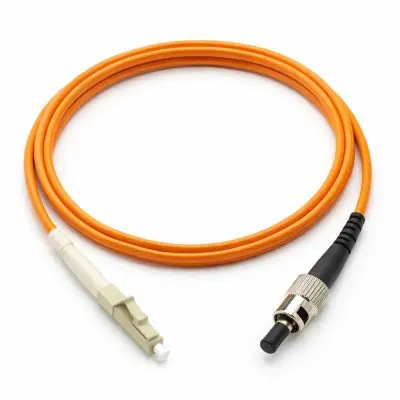
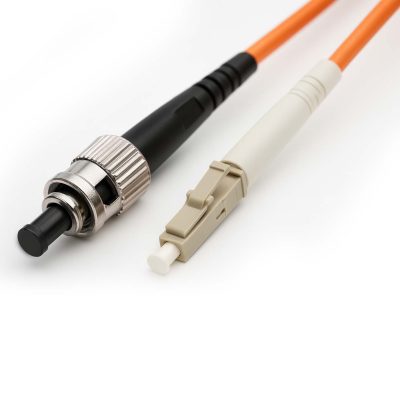
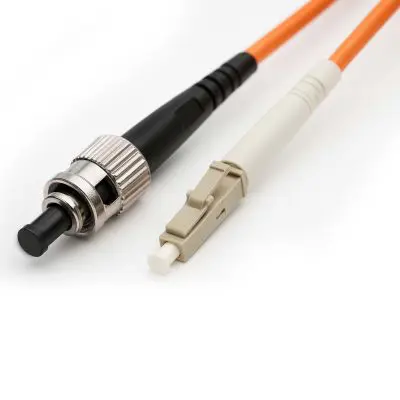
OM2 LC – ST Multi-Mode Simplex Fiber Jumper Cable — 3.0mm Orange Jacket
Multi-Mode Fiber Patch Cable
This OM2 LC to ST simplex fiber jumper cable provides dependable optical connectivity between fiber networking equipment, patch panels, and transceivers. The cable features a durable 3.0 mm orange jacket and precision-polished connectors, combining the compact LC connector with the rugged bayonet-style ST connector commonly used in enterprise, telecom, and legacy fiber environments.
Why these cables matter
- Mixed-connector compatibility — Ideal for connecting LC-based equipment to ST fiber panels or legacy infrastructure.
- Simplex fiber design — Single optical strand for one-direction transmission applications.
- Precision ceramic ferrules — Ensure low insertion loss and reliable signal transmission.
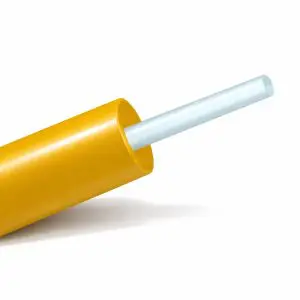
- Durable 3.0 mm jacket — Provides flexibility and protection in rack, cabinet, and patch-panel installations.
Rack Shelves Cable Management
Multi-Mode Fiber Types Overview
| Fiber Type |
Core Size |
Bandwidth |
Typical Data Rate |
Distance |
Common Applications |
| OM1 |
62.5 µm |
~200 MHz·km |
Up to 1 Gbps |
~275 m |
Legacy fiber installations |
| OM2 |
50 µm |
~500 MHz·km |
Up to 1 Gbps |
~550 m |
Enterprise and campus networks |
| OM3 |
50 µm (laser optimized) |
~2,000 MHz·km |
Up to 10 Gbps |
~300 m |
High-speed data center backbone |
| OM4 |
50 µm (advanced laser optimized) |
~4,700 MHz·km |
10–100 Gbps+ |
~550 m (10 Gbps)
~150 m (40/100 Gbps) |
High-performance data center networks |
Quick Summary
The main differences between OM1, OM2, OM3, and OM4 multimode fiber involve core size, bandwidth capacity, supported transmission distance, and maximum data rate. Higher-grade multimode fibers support faster speeds and longer distances, making them suitable for modern high-bandwidth networking environments.