
The Ball That Talks:
The FIFA World Cup 2026 is already historic. For the first time
Learn More →

The FIFA World Cup 2026 is already historic. For the first time ever, the tournament spans three nations — the United States, Canada, and Mexico — across 16 host cities and 104 matches. Over a billion people worldwide are watching it unfold. But there’s a story happening inside every single match that most fans will never see: a story about connectivity, data transmission, and real-time network performance.
That story lives inside the official match ball: the adidas TRIONDA.
At Gruber Communication Products, we spend every day thinking about how data moves through copper, through fiber, through connectors, and across networks. When we dug into the technology powering the TRIONDA, we recognized something familiar: a purpose-built, performance-critical data link operating in a demanding environment. Here’s what we found.
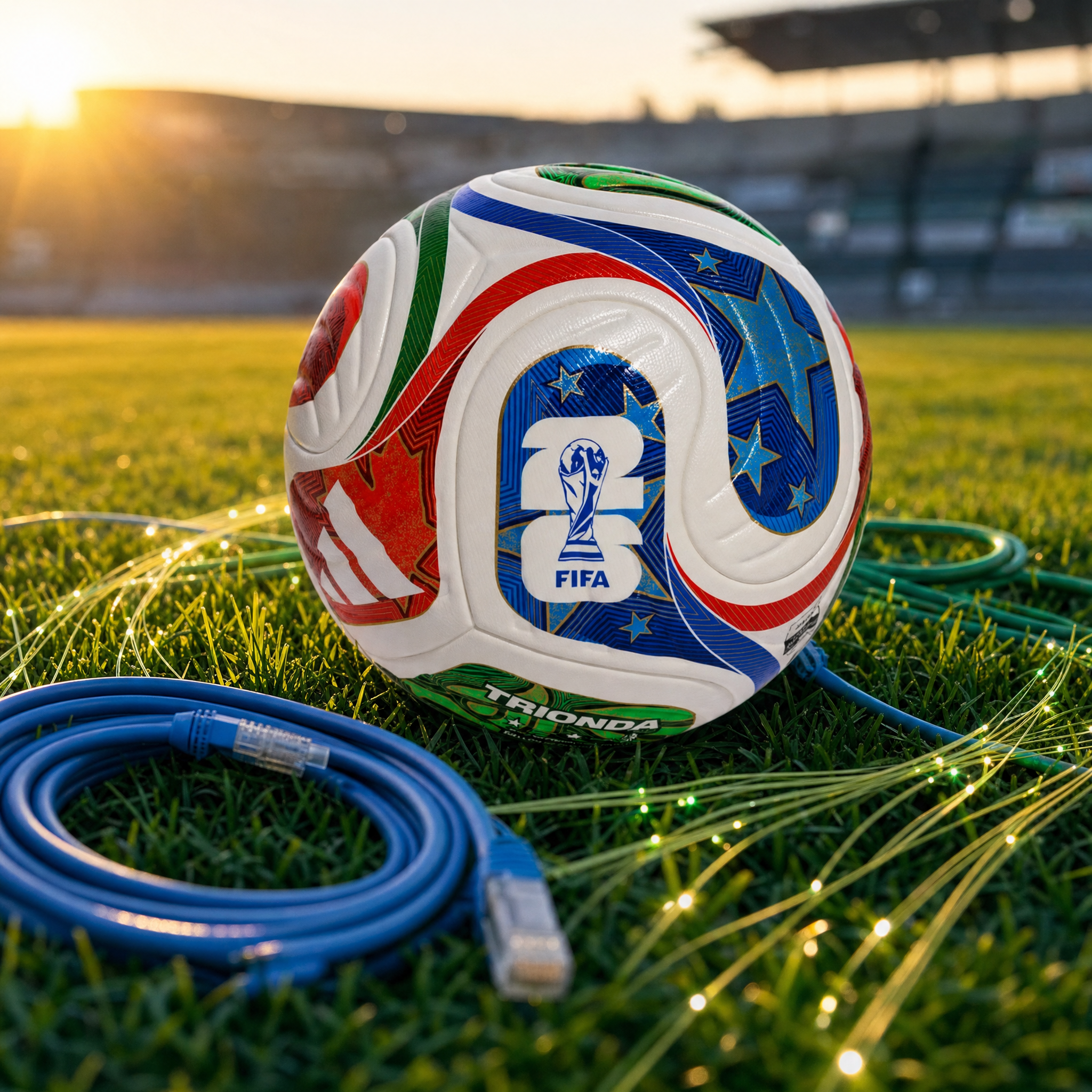
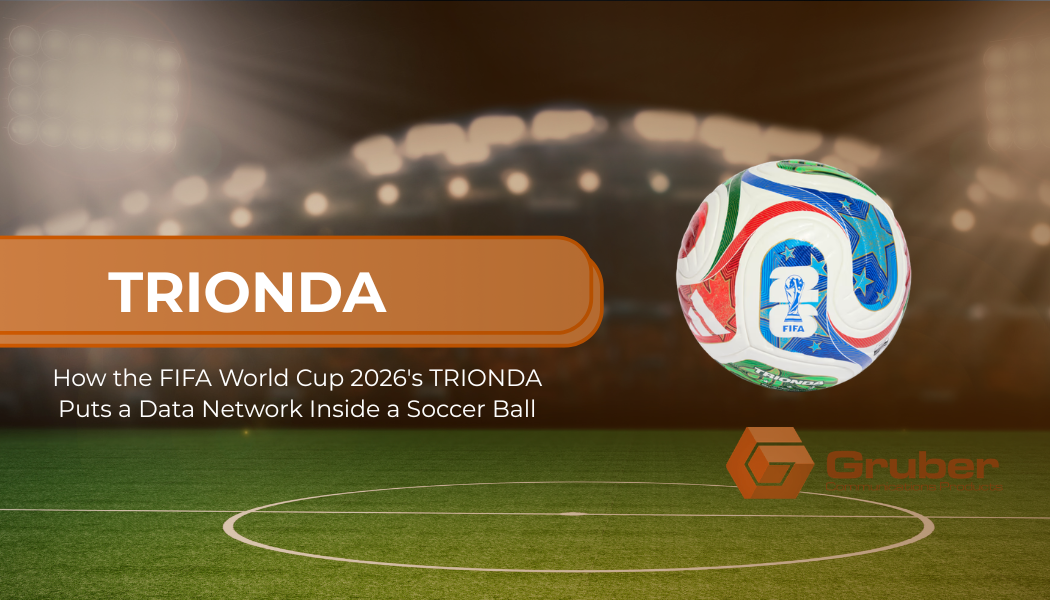
The TRIONDA is the official adidas match ball for the 2026 FIFA World Cup. Its name blends the Spanish prefix “tri-” (three) and “onda” (wave), a reference to both the three co-host nations and the flowing, wave-inspired panel design that wraps the ball.
Visually, the TRIONDA is a celebration of the Americas. Its four-panel construction features red, green, and blue, one color for each host nation, accented with gold to honor the FIFA World Cup Trophy. Embossed icons appear across the surface: a star for the United States, a maple leaf for Canada, and an eagle for Mexico. All three colors and symbols converge at the center of the ball in a triangle, symbolizing the historic union of the three host countries.
But beneath that striking exterior lives something far more technically interesting.
For the first time in World Cup history, the TRIONDA features adidas Connected Ball Technology with a side-mounted chip system. This isn’t a novelty , it’s a precision engineering achievement.
The sensor chip is embedded into one of the four panels and counterbalanced across the remaining three to ensure the ball’s weight distribution and flight characteristics remain true to a standard match ball. Players shouldn’t — and reportedly don’t — feel any difference.
Here’s what that chip does:
“At the core of the system is a motion sensor chip that records and transmits data up to 500 times per second, capturing every touch, movement, speed, and trajectory during a match.” — Storyboard18
The practical result: referees get faster, more accurate information. A system that once required lengthy VAR reviews for tight offside calls can now pinpoint the exact millisecond a player touched the ball, because the ball itself told the system.
The TRIONDA’s connected ball technology is a microcosm of a broader shift happening across industries: the push to embed intelligence and real-time data transmission into every physical object. This is the Internet of Things (IoT) applied at the highest levels of global sport.
The challenges involved are exactly the kind of problems our industry solves at scale every day:
Think about what’s happening at a World Cup stadium during a live match. The TRIONDA’s chip is transmitting at 500Hz. That data is flowing through a wireless link to match officiating systems. Those systems are piping it into AI processing pipelines. Decisions are being rendered in near real time, in front of a crowd of 90,000 people and broadcast to hundreds of millions more.
The stadium infrastructure — the cabling, the network switches, the fiber backbone — has to be ready to support it all. This is where the physical layer of connectivity still matters enormously, even in a wireless world.
The TRIONDA isn’t just smart , it’s engineered for aerodynamic performance. Its four-panel construction uses intentionally deep seams to create consistent, evenly distributed drag as the ball moves through the air. The textured, debossed surface improves grip in wet or humid conditions — critical for outdoor play across North American climates ranging from Kansas City humidity to Los Angeles heat.
The seamless, thermally bonded surface reduces water uptake, keeps the ball’s weight predictable over 90 minutes of play, and helps maintain shape retention. The ball earned FIFA Quality Pro certification, the highest rating FIFA awards, following extensive testing on weight, water uptake, shape retention, and trajectory consistency.
All of this matters because data integrity depends on physical integrity. A ball that changes weight as it absorbs water or deforms unevenly under impact would corrupt the sensor data the connected ball technology is collecting. The engineering of the physical enclosure and the electronics inside it are inseparable concerns.
That principle — that physical infrastructure and digital performance are always interconnected — is one we apply to every project at Gruber Communications.
We’re a structured cabling and connectivity company, not a soccer equipment manufacturer. But what we see in the TRIONDA is a familiar problem set: how do you transmit high-quality data reliably, in a physically demanding environment, at the speeds that real-time decisions require?
That question drives everything from stadium network design to industrial IoT deployments to enterprise data centers. The TRIONDA is just one of the more dramatic examples of what happens when the answer to that question actually works—and the global audience notices when it doesn’t.
At Gruber Communications, we supply the connectors, cabling infrastructure, and expertise that keep physical networks performing at that level. Whether it’s Cat6A copper cabling for high-density patch fields, fiber assemblies for backbone runs, or Neutrik industrial connectors for mission-critical deployments, the physical layer is never an afterthought.
The TRIONDA proves that even in a wireless, AI-driven world, the integrity of the physical connection—and the hardware that supports it—determines whether the system works when it counts.
The FIFA World Cup 2026 is underway, with 48 teams competing across 16 cities in three countries. It’s the largest World Cup in history, and it’s generating more data, from ball sensors, player tracking, broadcast systems, and stadium operations, than any tournament before it.
The TRIONDA is part of that story. So is the cabling that runs under stadium floors, the patch panels in broadcast facilities, and the fiber links connecting every venue to the networks carrying the tournament to the world.
As the matches play out, we’re watching — not just as fans, but as people who care about how the infrastructure behind it all performs. The best moments in global sport depend on connections that never fail. That’s something we understand deeply.
Learn more about Gruber Communications’ connectivity products and solutions at grubercommunications.com.
The FIFA World Cup 2026 is already historic. For the first time
Learn More →
The world’s eyes are on North America as FIFA World Cup 2026
Learn More →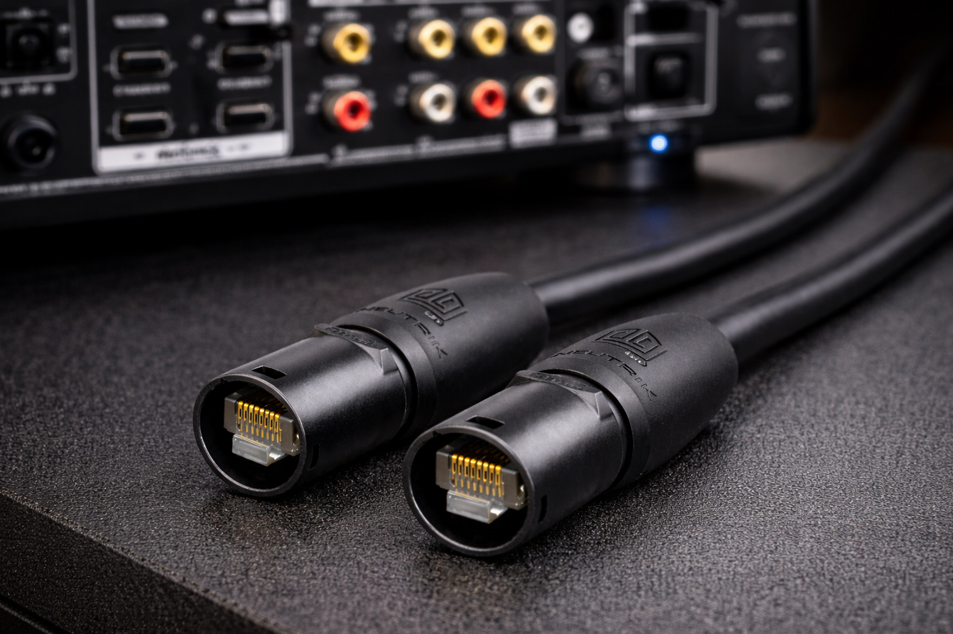
In professional live events, broadcast production, and mission-critical networking, the quality of
Learn More →