Industrial Robotic Arms — Automotive Manufacturing Robots
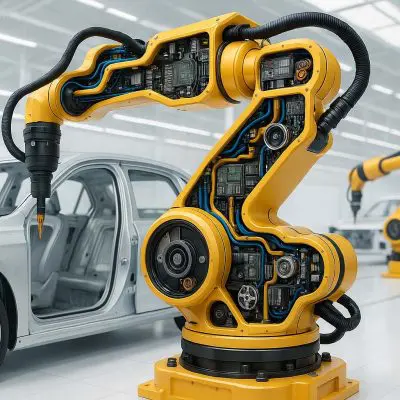
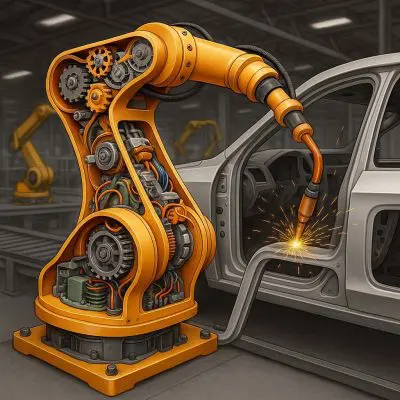
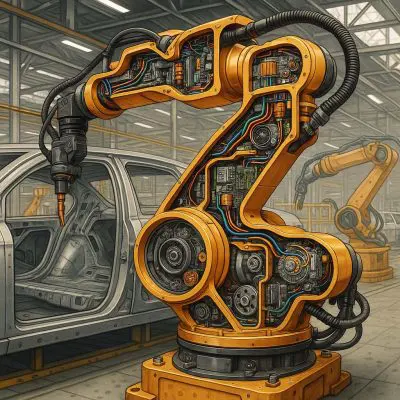
Industrial robotic arms are the backbone of modern automotive manufacturing, performing highly repetitive, precise, and physically demanding tasks with exceptional speed and reliability. Unlike humanoid robots, these purpose-built automation systems are engineered for specific manufacturing operations such as welding, painting, assembly, material handling, machine tending, adhesive dispensing, and quality inspection.
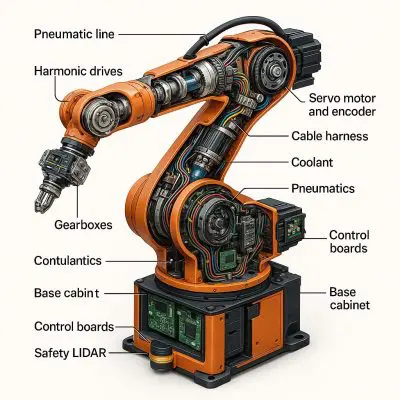
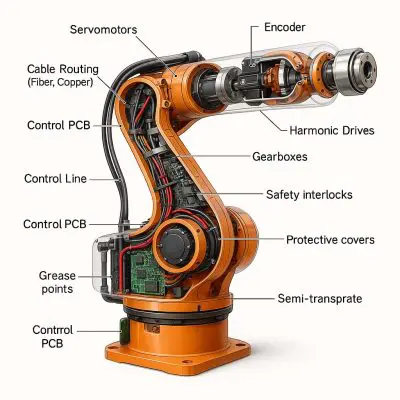
Found throughout automotive assembly plants, industrial robots help manufacturers increase production efficiency, improve product consistency, reduce workplace injuries, and operate around the clock with minimal downtime. These robots often feature multiple servo-controlled axes, integrated sensors, vision systems, advanced controllers, and sophisticated cable management systems designed to withstand continuous motion and harsh industrial environments.
🤖 Common Robot Types
- Articulated Robots — multi-axis robotic arms used for welding, assembly, material handling, and general automation.
- Spot Welding Robots — specialized systems designed for high-speed automotive body welding operations.
- Arc Welding Robots — automated welding platforms for structural and fabrication applications.
- Painting Robots — precision-controlled robots used for automotive painting and coating processes.
- Material Handling Robots — transfer components, parts, and assemblies throughout production lines.
- Machine Tending Robots — load and unload CNC machines, presses, and manufacturing equipment.
- Assembly Robots — perform repetitive fastening, installation, and component assembly tasks.
- Inspection Robots — equipped with cameras and sensors for automated quality control.
📐 Typical Specifications
| Metric |
Typical Range |
| Degrees of Freedom |
4–7+ axes |
| Payload Capacity |
5 kg to 2,500+ kg |
| Reach |
500 mm to 4+ meters |
| Repeatability |
±0.02 mm to ±0.1 mm |
| Operating Environment |
Factory, automotive, industrial production |
| Controller Integration |
PLC, Ethernet/IP, PROFINET, EtherCAT, DeviceNet |
| Vision Systems |
Optional AI, camera, laser, and inspection systems |
| Duty Cycle |
24/7 industrial operation |
⚙️ Automotive Applications
- Body-in-White Production — spot welding, joining, and structural assembly.
- Paint Shops — automated painting, coating, and finishing operations.
- Powertrain Manufacturing — engine, motor, gearbox, and driveline assembly.
- Battery Production — EV battery assembly, welding, testing, and material handling.
- Final Vehicle Assembly — installation of components, glass, seats, doors, and interior systems.
- Quality Inspection — machine vision and automated defect detection.
- Packaging & Logistics — palletizing, depalletizing, and warehouse automation.
🔌 Robot Cabling & Motion Systems
Industrial robots depend on highly specialized wiring systems designed to survive millions of cycles of continuous motion. Robot harnesses frequently pass through wrists, elbows, shoulders, rotary joints, cable tracks, and internal arm routing channels where standard cable would quickly fail.
Common robotic interconnects include:
- Motion-rated power cables
- Servo motor cable assemblies
- Encoder and feedback harnesses
- Industrial Ethernet cables
- Sensor and vision system wiring
- End-of-arm tooling (EOAT) cable assemblies
- Pneumatic and hybrid electro-mechanical harnesses
- High-flex communication interconnects
Why Choose Industrial Robots?
- Exceptional precision for demanding manufacturing processes.
- High throughput with continuous production capability.
- Improved safety by reducing human exposure to hazardous operations.
- Consistent quality with repeatable automated performance.
- Scalable automation for both traditional and electric vehicle manufacturing.
- Reduced operating costs through increased productivity and lower rework rates.
Gruber designs, manufactures, repairs, and supports custom wiring harnesses, motion-rated cable assemblies, robot interconnects, servo wiring systems, sensor harnesses, and communication cabling used throughout industrial robotic platforms, automotive production equipment, and advanced manufacturing systems.