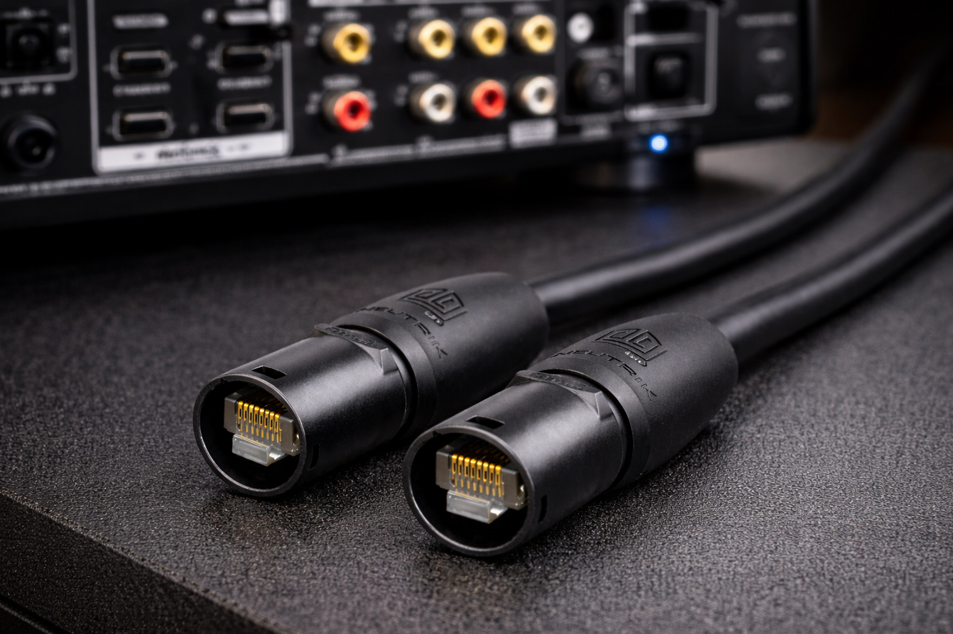
Neutrik etherCON® Assemblies: Unlock
In professional live events, broadcast production, and mission-critical networking, the quality of
Learn More →

As our reliance on fast, stable internet connections grows, so does the importance of choosing the right type of cabling for your network. Whether you’re setting up a home office, managing a corporate IT infrastructure, or building a large-scale industrial system, the cables you install today will directly impact your performance tomorrow.
Three of the most common network cabling options of Cat5e, Cat6a, and Fiber Optics each serve distinct roles. While they may all carry data, their construction, speed capabilities, interference resistance, and costs are very different.
This blog dives into the differences, practical use cases, and considerations to help you choose the best cable type for your specific needs.
Ethernet cabling has gone through several generational upgrades, each improving speed, bandwidth, and shielding. Cat5e, introduced in the early 2000s, was an enhancement over Cat5 and quickly became the standard for gigabit Ethernet. As network demands increased, Cat6a (Category 6 Augmented) emerged as a more capable successor, offering higher speeds and better noise resistance. Likewise, Fiber Optics has long been the go-to for long-distance, high-bandwidth data transmission particularly in data centers, telecoms, and enterprise backbones.
Each cable type has its place, but understanding their individual strengths and limitations is key to making an informed decision.
Cat5e (Category 5 Enhanced) cables are still widely used today, especially in residential and small office environments. They can support up to 2.5 Gigabit per second (Gbps) speeds over a maximum distance of 100 meters.
One of the primary advantages of Cat5e is its affordability and ease of installation. The cable is thin and flexible, making it easy to route through walls or tight spaces. It’s compatible with most standard 8p8c RJ45 connectors and most networking hardware.
However, Cat5e is limited in terms of bandwidth (100 MHz) and has minimal protection against crosstalk and electromagnetic interference (EMI). In environments where signal noise is high, such as near power lines or heavy machinery, Cat5e may struggle to maintain consistent performance. It also lacks future proofing for multi-gigabit networks.
Cat6a is quickly becoming the standard for modern enterprise and industrial cabling. It supports 10 Gbps speeds over 100 meters and delivers up to 500 MHz bandwidth ideal for high-speed data transfer, video conferencing, and cloud-based systems.
What makes Cat6a stand out is its advanced shielding, such as F/UTP or S/FTP, which significantly reduces crosstalk and external interference. Some Cat6a cables also feature a longitudinal isolator—a key component that blocks EMI from adjacent wires and helps prevent data loss; novel constructions can do away with even this for further cable diameter reductions.
While thicker and less flexible than Cat5e, the improved performance, durability, and reliability make Cat6a the smart choice for high-demand environments like server rooms, manufacturing plants, and broadcast studios.
Unlike copper-based Cat5e and Cat6a cables, fiber optic cables use light to transmit data. This allows them to achieve extremely high speeds, with support for 10 Gbps, 40 Gbps, 100 Gbps, and beyond, depending on the type of fiber and the equipment used. Fiber is also immune to electromagnetic interference, making it the most reliable option in electrically noisy environments.
There are two primary types of fiber:
While fiber offers exceptional speed and future scalability, it comes with higher material and installation costs. Fiber cables are more fragile and require precision termination, laser-aligned connectors, and often trained technicians for proper installation. However, once installed, fiber optics offer minimal signal loss, excellent security (harder to tap), and virtually unlimited bandwidth potential.
| Feature | Cat5e | Cat6a | Fiber Optic |
| Max Data Rate | 1 Gbps | 10 Gbps | 1–100+ Gbps |
| Bandwidth | 100 MHz | 500 MHz | Extremely high (up to THz range) |
| Max Distance (at top speed) | 100 meters | 100 meters | Up to 40 km (type dependent) |
| EMI Resistance | None (if UTP) | High | Excellent (immune) |
| Installation | Simple and flexible | Moderate, more rigid | Complex, fragile, requires expertise |
| Cost | Low Average | Moderate | High Typically |
| Use Cases | Home/office, VoIP | Business, industrial, PoE | Long-distance, high-speed signal systems |
Choosing between Cat5e, Cat6a, and fiber optics depends on several key factors:
Network cabling is something you may want to revisit every year. Selecting the right cable now can ensure stable performance, support for emerging technologies, and minimal downtime in the future. While Cat5e can be sufficient for low-demand applications, it’s effectively obsolete for high-performance network applications currently available today. Cat6a offers a robust middle ground solution, supporting modern speeds and shielding against interference at reasonable prices. Being the most complex and costly, Fiber Optics offers unbeatable speed, distance, and futureproofing for growing infrastructures.
Before deciding, consider your current and future needs carefully. Investing in the right cabling now can save you significant time, expense, and effort later.
At Gruber Communications, we specialize in helping businesses make informed decisions with expert guidance and high-quality products. Whether you need off-the-shelf cables or custom-built assemblies, our in-house cable manufacturing capabilities ensure you get exactly what your project requires.
Contact us today to discuss your cabling needs or explore our range of networking products and services.
In professional live events, broadcast production, and mission-critical networking, the quality of
Learn More →
Efficient cable management is essential in today’s data centers, telecom rooms, and
Learn More →