
The Ball That Talks:
The FIFA World Cup 2026 is already historic. For the first time
Learn More →

Cables from Gruber Communications
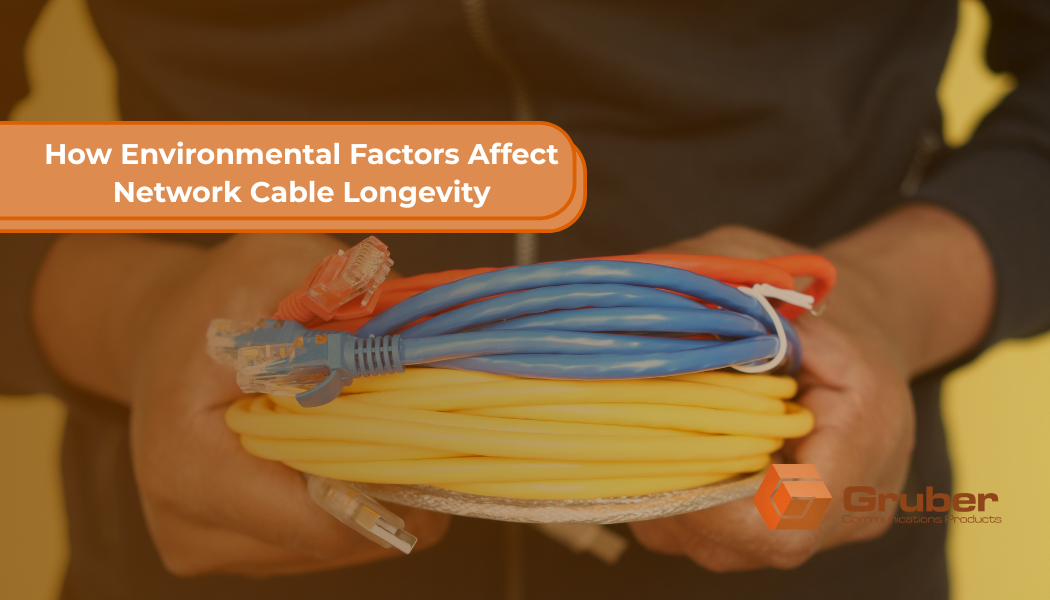
In today’s always-connected world, network cabling is the backbone of communication systems across offices, data centers, industrial facilities, and outdoor environments. While much attention is given to bandwidth, speed, and standards like power, one critical factor is often overlooked: the environment in which the cable operates.
Environmental conditions can significantly impact the performance, reliability, and lifespan of network cables. Understanding these factors and choosing the right products for each environment can help businesses avoid downtime, reduce maintenance costs, and extend the life of their network infrastructure. At Gruber Communications, we design and manufacture communication products with real-world environments in mind, ensuring durability and long-term performance for your critical connections!
Temperature is one of the most influential environmental factors affecting network cables. Excessive heat can cause cable jackets to soften, deform, or crack over time, while extreme cold can make materials brittle and prone to breakage.
In data centers, poor airflow or overcrowded racks can trap heat, accelerating insulation degradation. In industrial or outdoor environments, cables may be exposed to fluctuating temperatures that cause expansion and contraction. This repeated thermal stress can weaken conductors and compromise signal integrity.
Gruber Communications offers cable solutions engineered to withstand demanding temperature conditions without sacrificing performance.
Moisture is one of the most damaging environmental threats to network cabling. High humidity can lead to corrosion of copper conductors, while direct water exposure can cause short circuits, signal loss, and complete cable failure.
In environments such as basements, warehouses, outdoor runs, or near HVAC systems, condensation is a common issue. Even small amounts of moisture can penetrate poorly sealed cable jackets over time, leading to oxidation and reduced conductivity.
Choosing high-quality, well-sealed communication products is essential for maintaining long-term reliability in humid or wet environments.
Ultraviolet (UV) radiation from sunlight can degrade cable jackets over time, especially those made for indoor use. Prolonged UV exposure causes materials to become brittle, crack, and eventually fail, exposing internal conductors to further environmental damage.
This is a common issue for outdoor cable runs, rooftop installations, and temporary deployments that become permanent solutions.
Cables are often subjected to bending, pulling, crushing, and vibration, especially in industrial settings or high-traffic areas. Excessive mechanical stress can damage internal conductors, loosen connectors, and degrade signal performance.
Common sources of physical damage include:
Investing in robust cable management systems not only protects cable but also improves organization and scalability.
In manufacturing plants, laboratories, and industrial facilities, cables may be exposed to oils, solvents, acids, and other chemicals. These substances can react with cable jackets, causing them to swell, crack, or degrade prematurely.
Standard indoor cables are not designed to withstand chemical exposure, making proper material selection critical.
Gruber Communications understands the demands of industrial environments and provides solutions built to perform where standard cabling falls short.
Environmental electromagnetic interference can also impact cable longevity and performance. High levels of EMI from power lines, motors, or heavy electrical equipment can introduce noise, reduce data integrity, and increase error rates.
Over time, constant exposure to interference can stress cable shielding and connectors.
High-quality shielding and construction help preserve signal quality even in electrically noisy environments.
Selecting the right network cable is not just about speed or a specific regulatory rating—it’s about matching the product to the environment. Using indoor-rated cables outdoors or standard cables in industrial settings may reduce upfront costs, but it often leads to higher long-term expenses due to failures, replacements, and downtime.
At Gruber Communications, our connectivity solutions are designed with durability, performance, and real-world conditions in mind. By considering environmental factors during the planning and installation phases, businesses can build networks that last longer, perform better, and require less maintenance.
Environmental factors play a crucial role in determining how long network cables last and how well they perform. Temperature extremes, moisture, UV exposure, mechanical stress, chemicals, and electromagnetic interference all contribute to cable degradation when not properly addressed.
By choosing high-quality, environment-appropriate communication products and following best installation practices, organizations can protect their network investments and ensure reliable connectivity for years to come.
For the full catalog of our products and services, please visit our website: Home – Gruber Communications
If you have questions about selecting the right cabling solutions or need support with your communication infrastructure, our team is here to help!
Phone: 800.658.5883 or 602.863.2655
Email: support@gruber.com
At Gruber Communications, we’re committed to delivering reliable, high-quality communication products designed to perform in real-world environments today and into the future.
The FIFA World Cup 2026 is already historic. For the first time
Learn More →
The world’s eyes are on North America as FIFA World Cup 2026
Learn More →
In professional live events, broadcast production, and mission-critical networking, the quality of
Learn More →